Human or Machine?
An interactive learning experience with focus on AI. A part of the museum installation "Ambivalent Intelligens".
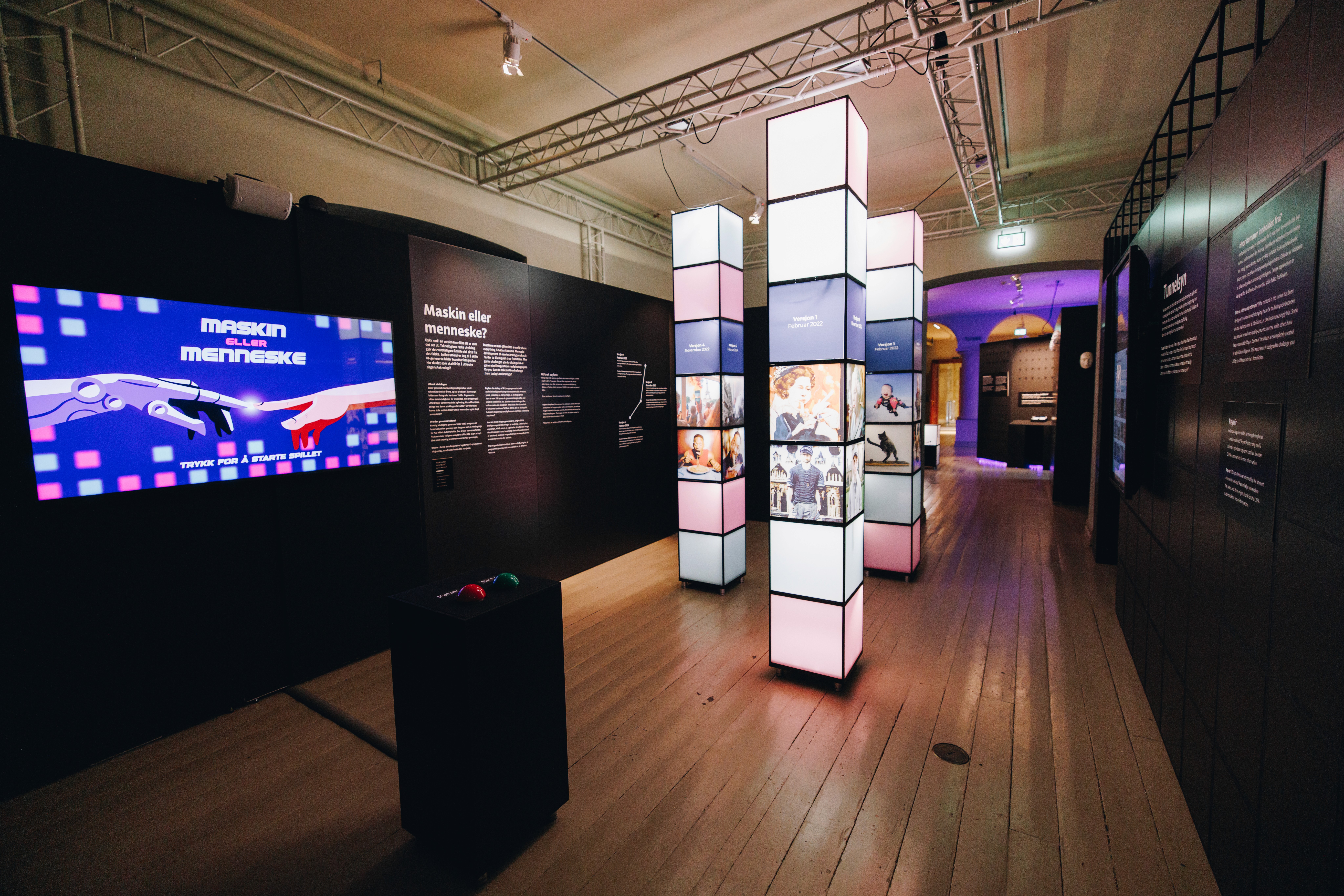
Human or Machine is an interactive museum installation that challenges visitors to identify whether an image is a photograph or generated by AI.
The project explores trust, Artificial Intelligence, and how playful interaction can make people reflect on the boundaries between humans and machines.*
Client
University Muesum of Bergen
Skills
UX design (visual and physical)
UI and visual identity
Interactive prototyping
User research & testing
Prompt engineering
Game development
My role
UX designer, Curator of AI images
Timeline
Q1 2024 - Q2 2024
Team
A team of 5 UX-students from University of Bergen, collaborating with the museum-curators.
Problem
Can we spot the difference?
Users currently encounter DR’s digital universe as fragmented, with TV, Lyd, and Nyheder existing in separate silos. Especially for younger audiences, this makes it difficult to navigate and to see the full value of DR’s offerings. At the same time, personalisation has become a standard in commercial platforms, but is often powered by opaque algorithms that compromise transparency and trust.
This tension opened a design space for us: how might DR offer personalisation that strengthens coherence across platforms, while remaining true to its role as a public service broadcaster?
Solution
Transparent personalisation
MIT-DR is a unified entry point to DR’s digital universe, where onboarding gives users simple choices to personalise their experience while staying in full control.
One login across platforms
A single profile gives access to DR TV, Lyd, and Nyheder.
Personalised preferences
Users select their own topics and interests instead of being guided by algorithms.
Transparent personalisation
Full control over what data is used and how recommendations are shaped.
Seamless cross-platform experience
Profile settings follow the user across devices and services.
Public service values intact
Personalisation strengthens engagement without compromising trust or DR’s societal role.
Design process
The designprocess was iterative, using a version of the double diamond design process. It includes moving between divergent (opening up) and convergent (narrowing down) phases to understand a problem and develop a solution.
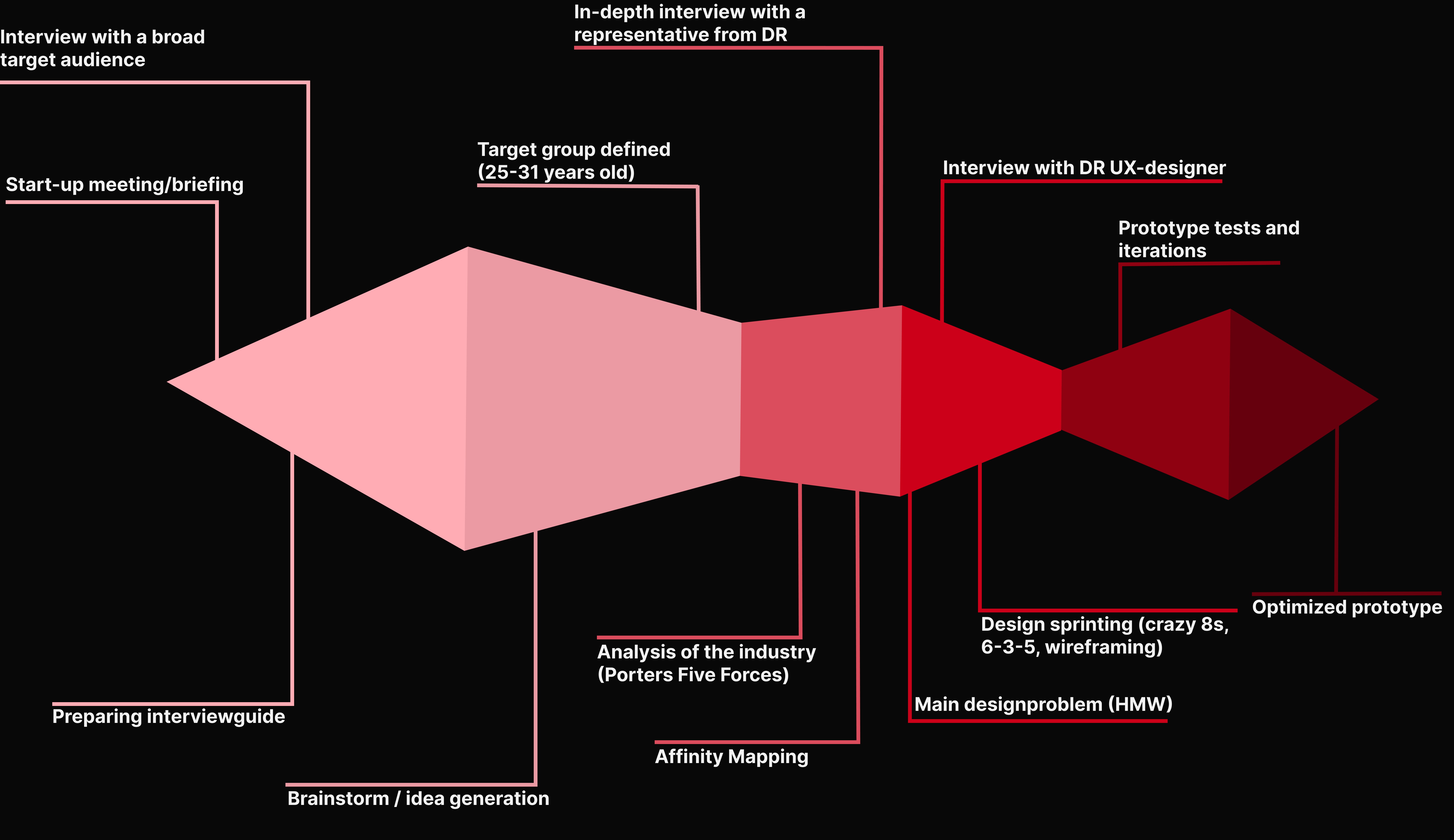
User interviews
Two rounds of interviews to gain different knowledge of our user group and how the platform is perceived.
We conducted interviews with 8 different users ranging from 25-31 years old.
Research questions:
Do you have a DR user profile? Why or why not?
How did you experience the process of creating an account and logging in?
What would make your experience more personal or relevant?
How do you experience the connection between DR’s platforms?
What expectations do you have for a public service platform regarding login, data handling, and personalisation?
Research insights
Insights are based on survey responses and follow-up interviews with young users. The data were sorted doing Affinity Mapping and narrowing the insights into themes.
Fragmented experience
Users experienced DR TV, Lyd, and Nyheder as excluded from each other.
Personalisation with caution
Users wanted relevant and tailored content, but expressed skepticism toward a public service provider with algorithmic recommendations. Transparency and control were seen as essential because of DRs role as a public service provider.
Login as a barrier
Mandatory login was perceived as inconvenient, but could be accepted if it provided clear benefits like favorites, recommendations, or “continue watching.”
Trust as a differentiator
Unlike commercial platforms, DR was seen as a trusted source. Users expected DR to uphold transparency, neutrality, and public service values in its personalisation approach.
Young users seek relevance
The 25–31 age group expected a seamless, modern experience across platforms, similar to global streaming services, but still aligned with DR’s role as a public service provider.
Concept ideation
To shape the concept, we explored how competing platforms communicate personalisation. This competitive scan helped us define four core features:
Clear purpose of login
Users are told why login matters and what value it unlocks.
User-selected topics
Personalization is based on explicit choices, not behavioural tracking.
Simple overview of preferences
Users can easily view and adjust their selected interests.
Transparent personalization
Tailored content is clearly marked so users know why it appears.
Building on these principles, we moved into rapid ideation. We ran Crazy 8s and 6-3-5 ideation sessions to generate a broad range of directions, then converged through lo-fi wireframes that made the concept tangible. These early sketches were tested with users to validate assumptions, refine the core flow, and ensure that transparency and user control remained central throughout the design.
HI-FI testing and user inputs
To shape the concept, we explored how competing platforms communicate personalisation. This competitive scan helped us define four core features:
Clear purpose of login
Users are told why login matters and what value
Reflections
To shape the concept, we explored how competing platforms communicate personalisation. This competitive scan helped us define four core features:
Clear purpose of login
Users are told why login matters and what value it unlocks.
User-selected topics
Personalization is based on explicit choices, not behavioural tracking.
Simple overview of preferences
Users can easily view and adjust their selected interests.
Transparent personalization
Tailored content is clearly marked so users know why it appears.
Building on these principles, we moved into rapid ideation. We ran Crazy 8s and 6-3-5 ideation sessions to generate a broad range of directions, then converged through lo-fi wireframes that made the concept tangible. These early sketches were tested with users to validate assumptions, refine the core flow, and ensure that transparency and user control remained central throughout the design.